14.3 million files in RAM: how I built local hybrid search in Rust
24-byte entries, 64-bit bitmasks, Tantivy BM25, int8 Model2Vec vectors, and why I refused to write a root daemon
By Ty · · 14 min read · systems
Tags: #cloudwerx-os #rust #search #linux #tantivy #embeddings #cachyos #wayland
If you ever used Voidtools Everything on Windows and then moved to Linux, you probably felt the same itch I did. On Windows, you open a box, type half a filename, and it knows where every file on your drives lives before your finger even leaves the key. On Linux, half the time you're either waiting on find, kicking locate after an updatedb cron job missed the file you just saved ten minutes ago, or watching a desktop indexer chew through a CPU core in the background while your fans spin up.
When I built CLOUDWERX OS, I wanted my launcher (Super+Space) to do three things from the exact same text box without leaving my machine or needing a root daemon.
First, fuzzy name search across the entire filesystem, live as I type. Second, full-text search inside my documents, PDFs, Office files, and code. Third, search by meaning, so when I remember what a document is about instead of what words I used in it, I still find it in a few dozen milliseconds.
Right now, my laptop has 13,923,933 files and 407,002 folders indexed in memory. That's 14,330,935 entries sitting in RAM, plus 41,195 documents in a full-text index and 483,857 text passages turned into vectors for semantic search. The entire daemon (cloudwerx-searchd, written in Rust) sits around 930 MiB RSS (975,601,664 bytes) and takes roughly 742 MiB on disk.
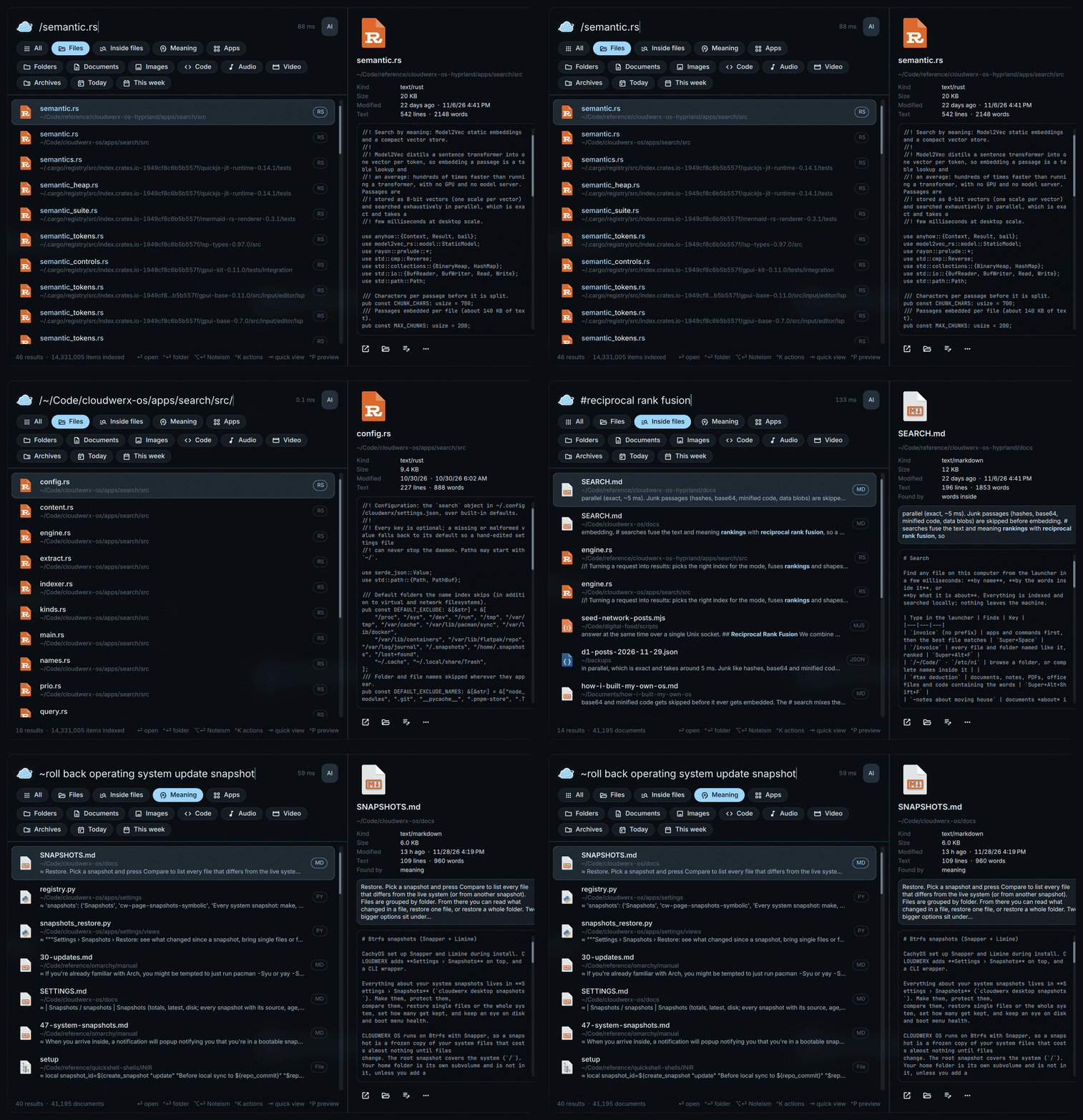
I want to walk through how it actually works under the hood, because almost every speed win came from a handful of very simple data layout choices rather than anything fancy.
Three indexes behind one Unix socket
The launcher itself (a Quickshell QML panel), the cloudwerx search CLI, and the Settings page all speak one line-delimited JSON protocol over $XDG_RUNTIME_DIR/cloudwerx-search.sock (mode 0600). None of them touch indexes directly.
flowchart TD
    UI["Launcher (Super+Space) / CLI / Settings"] -->|JSON lines over 0600 Unix socket| S["cloudwerx-search.sock"]
    S --> D["cloudwerx-searchd (Rust user service)"]
    D --> N["Tier 1: NameIndex in RAM (14.3M entries)"]
    D --> T["Tier 2: Tantivy BM25 (41,195 docs)"]
    D --> M["Tier 3: Model2Vec int8 Store (483,857 passages)"]
    W["inotify watcher (140,346 dirs)"] -->|live deltas + debounce| D
    T --> RRF["Reciprocal Rank Fusion (k = 60)"]
    M --> RRF
One tiny detail in server.rs makes typing feel way snappier than raw query times suggest. Every socket client gets a reader thread feeding a channel to a worker loop. When a burst of keystrokes arrives faster than a query finishes, the worker drains the channel and drops every older "op": "search" request in the queue, replying with "skipped": true to all of them except the last one. You never burn CPU finishing a query for "se" when the user already typed "semantic.rs".
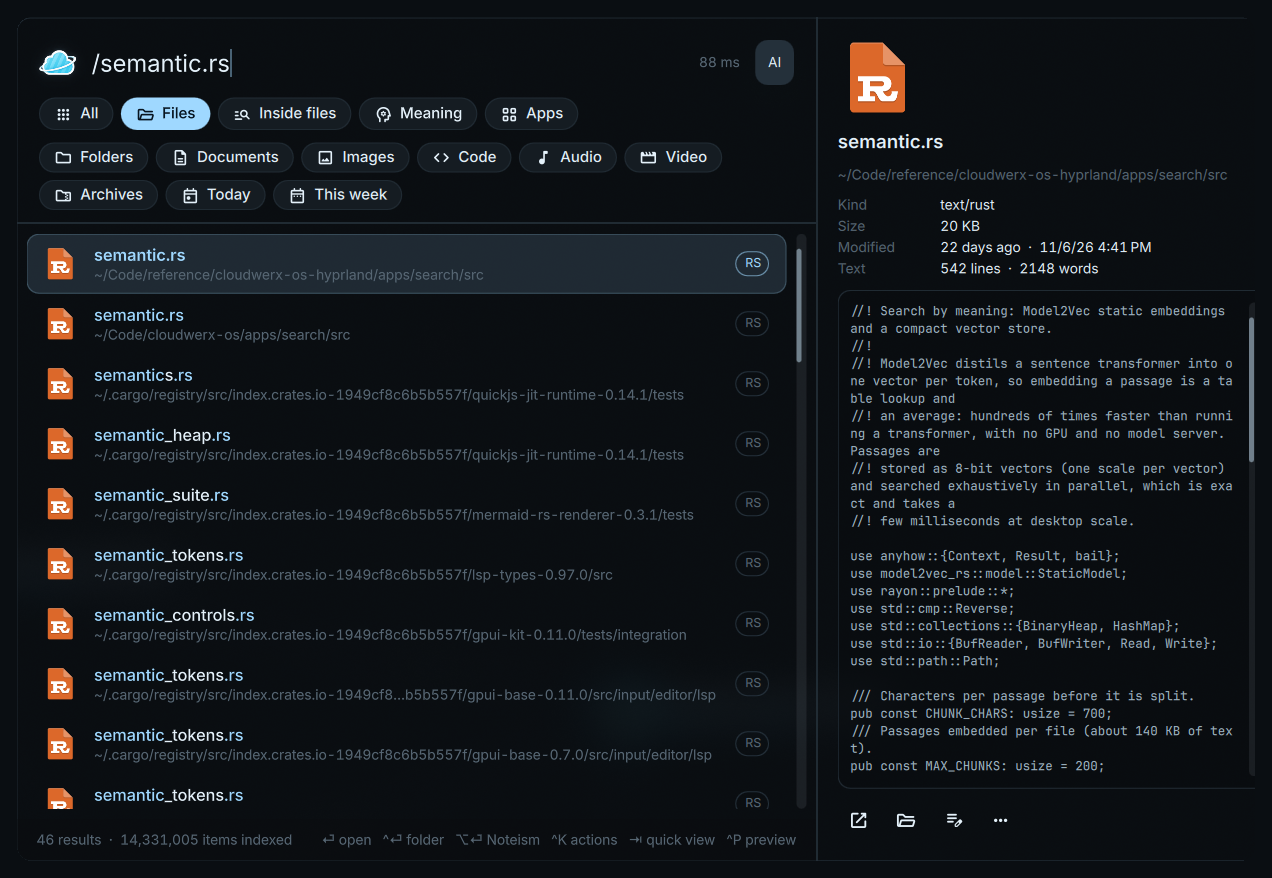
| Prefix | Mode | Engine | What it searches |
|---|---|---|---|
| (none) | All | Apps + NameIndex |
Launches apps first, then top file matches |
/ |
Files | NameIndex (nucleo + u64 mask) |
Every file and folder by name or path |
/~/Code/ |
Browse | NameIndex child list |
Instant folder listing and tab completion |
# |
Inside files | Tantivy BM25 + Model2Vec RRF |
Words inside files blended with meaning |
~ |
Meaning | Model2Vec (potion-retrieval-32M) |
Passages by conceptual similarity |
You can stack filters in every mode (ext:pdf, size:>10mb, mod:week, in:~/Documents, is:code), and if you hit Tab on any result, QuickView pops open right on top of the launcher so you can inspect a PDF, Markdown file, or 3D model without closing your search.
Tier 1: Packing 14.3 million entries into RAM
If you try to store 14.3 million PathBuf strings in Rust, you will hate your life. Every PathBuf is a heap allocation, most path prefixes repeat thousands of times across deep trees like ~/.cargo or node_modules, and iterating 14 million scattered heap pointers trashes your L3 cache before you even compare a single character.
Instead, names.rs splits the whole filesystem into two flat arrays and one giant contiguous string buffer:
#[derive(Clone, Copy, Debug)]
pub struct Entry {
    pub parent: u32,
    name_off: u32,
    name_len: u16,
    pub kind: u8,
    pub flags: u8,
    pub mtime: u32,
    pub size: u64,
}
Count those bytes: $4 + 4 + 2 + 1 + 1 + 4 + 8 = 24$ bytes per entry, Copy, zero pointers, and zero heap allocations per file. Only the basename is stored, appended into one big names: String arena. If a folder has 400 files inside it, the parent folder path isn't duplicated 400 times. It's just parent: u32.
Even better: when the parallel filesystem walker (scan.rs) builds the tree and hands it to NameIndex::add_tree, it inserts children breadth-first. Every sibling in the same folder ends up sitting right next to each other in entries: Vec<Entry>. When a query does need a full path (like in:work or code/srch), the hot loop keeps a one-entry ParentCache holding the last parent ID and its string path. Because siblings are adjacent in memory, parent_path.id == e.parent hits almost every single time without climbing the tree.
[!NOTE] Why not store one
u64insideEntry?masks: Vec<u64>lives in its own parallelVecinstead of insideEntry. During the hot scan, threads readmasks[id]sequentially (8 bytes per item, 8 items per 64-byte cache line) and only touch the 24-byteEntrystruct or thenamesstring arena if the bitmask passes.
The 64-bit character mask prefilter
Before Helix's fuzzy matcher (nucleo-matcher) ever sees a filename, score_entry checks a single 64-bit integer.
When an item is added to NameIndex, char_mask() folds its basename into a bitset: bits 0..25 for a..z (case-folded), 26..35 for 0..9, 36..39 for ., -, _, and space, bit 40 for other ASCII, and bit 63 (NON_ASCII) if any non-ASCII character appears.
At query time, needle_mask() computes the bitset $M_{\text{query}}$ of required characters in your search words once. Then for each entry $i$ with mask $M_i$, the rejection test is literally one bitwise operation:
$$ (M_{\text{query}} \land \neg M_i) \neq 0 \quad \text{and} \quad (M_i \land 2^{63}) = 0 $$
In Rust:
let have = self.masks[id as usize];
if p.mask & !have != 0 && have & NON_ASCII == 0 {
    return None;
}
Think about what that does when you type /semantic.rs. Every filename in the entire OS that lacks an s, e, m, a, n, t, i, c, ., or r gets tossed out in a couple of CPU cycles without decoding UTF-8, without touching names, and without calling nucleo. Only entries containing NON_ASCII bypass the mask (because Unicode smart normalization might fold é to e).
Once an entry clears the mask and metadata filters (ext:, size:, mod:), Rayon splits entries into chunks of 8192 items (par_chunks(8192)) across all cores. Each worker grabs a thread-local nucleo_matcher::Matcher and keeps a tiny min-heap (BinaryHeap<Reverse<(i32, u32)>>) of the top candidates in its chunk. Then a small bonus function breaks ties:
- Exact filename match:
+90, exact stem match:+70, prefix match:+25 - Inside
$HOME:+30 - Hidden file (unless you typed a dot or
hidden:yes):-45 - Noisy system or build folders (
/usr/lib,/var/lib,target,node_modules):-30 - Modified in the last 24h / 7d / 30d:
+18/+12/+6 - Shallower paths beat deeply nested ones (
-(depth - 3).clamp(0, 10) * 2) - Frecency boost from
~/.local/share/cloudwerx/search/usage.jsonfor files you actually opened before
Why I refused to use fanotify
People always ask why a Linux desktop search tool doesn't just use fanotify to watch the whole disk instead of inotify.
On Linux, inotify isn't recursive. You have to walk your directory tree and call inotify_add_watch on every single folder, one inode at a time. Right now cloudwerx-searchd holds 140,346 active inotify watches against a kernel limit (fs.inotify.max_user_watches) of 1,048,576. fanotify, by contrast, has FAN_MARK_MOUNT and FAN_MARK_FILESYSTEM, which watch an entire mount point recursively with zero races.
So why not use fanotify? Because mount-wide fanotify requires CAP_SYS_ADMIN (root), since fanotify can observe and even intercept file opens across every user on the system.
I refuse to put a root daemon on a desktop search bar. cloudwerx-searchd runs strictly as an unprivileged systemd user service (cloudwerx-search.service). Your home folder and content roots get live inotify updates within milliseconds of saving or renaming a file, and the rest of / (/usr, /etc, mounted drives) rescans in parallel every 20 minutes. A full walk of all 14,330,935 entries across / took 36,121 ms on last scan, running at nice 15 and IOPRIO_CLASS_IDLE so you never feel it.
Here's prio.rs if you want to steal those two Linux syscalls for your own background Rust indexers:
pub fn lower_current_thread() {
    unsafe {
        let tid = libc::syscall(libc::SYS_gettid) as libc::id_t;
        libc::setpriority(libc::PRIO_PROCESS, tid, 15);
        const IOPRIO_WHO_PROCESS: libc::c_long = 1;
        const IOPRIO_CLASS_IDLE: libc::c_long = 3;
        libc::syscall(libc::SYS_ioprio_set, IOPRIO_WHO_PROCESS, tid as libc::c_long, IOPRIO_CLASS_IDLE << 13);
    }
}
And one subtle glibc detail in prio.rs: after a big full-disk rescan swaps out the old 14.3M-entry NameIndex for a fresh one, the watcher calls libc::malloc_trim(0). Without that, glibc holds onto freed heap arenas and RSS stays inflated by hundreds of megabytes after every rebuild.
Tier 2: Full-text search without Tantivy's QueryParser
For # searches (words inside files), cloudwerx-searchd embeds Tantivy (0.26), the Rust full-text engine inspired by Lucene. It extracts text from plain text, Markdown, HTML (stripped cleanly), source code, PDFs (via pdftotext -l 300 with a 30-second timeout), and zipped XML office documents (.docx, .xlsx, .pptx, .odt, .ods, .odp, .epub).
[!WARNING] Zip bomb protection Cracking open
.docxand.xlsxfiles inside a background indexer means parsing untrusted archives from~/Downloads.extract.rscaps any single decompressed zip member at32 MiB(MAX_ZIP_MEMBER) and stops reading extracted text per file at1,000,000characters (MAX_TEXT), while skipping lockfiles and.min.js/.min.css/.mapbundles completely.
Here's the interesting part in content.rs: I did not use Tantivy's built-in QueryParser.
Standard query parsers expect complete words and choke on partial syntax while someone is mid-word. If you type #deduc, you want Deductible to pop up right now, before you finish typing tion.
Because Tantivy stores each field's term dictionary as a Finite State Transducer (FST), content.rs builds queries by hand. For the word you're actively typing (or any word of 3+ chars, or 2+ chars if it's the trailing partial word), expand_prefix opens a byte range stream [prefix, prefix + 1) on the inverted index across segments, reads up to 4,000 matching terms, sorts by document frequency, and expands the top 24 most common completions (PREFIX_TERMS = 24) as 0.7x-weighted Should clauses alongside the exact term (1.0x). Matches in the filename (name field) also get a 2.0x BoostQuery over body.
let mut upper = prefix.as_bytes().to_vec();
if let Some(last) = upper.last_mut() {
    *last = last.saturating_add(1);
}
for seg in searcher.segment_readers() {
    let Ok(inv) = seg.inverted_index(field) else { continue };
    let Ok(mut stream) = inv.terms().range().ge(prefix.as_bytes()).lt(&upper).into_stream() else { continue };
    // collect top 24 completions by doc_freq
}
No regex scans, no slow wildcards. Just an FST range walk, BM25 scoring, exact "quoted phrases", -negation, and SnippetGenerator highlights.
Tier 3: Semantic search with Model2Vec and int8 quantization
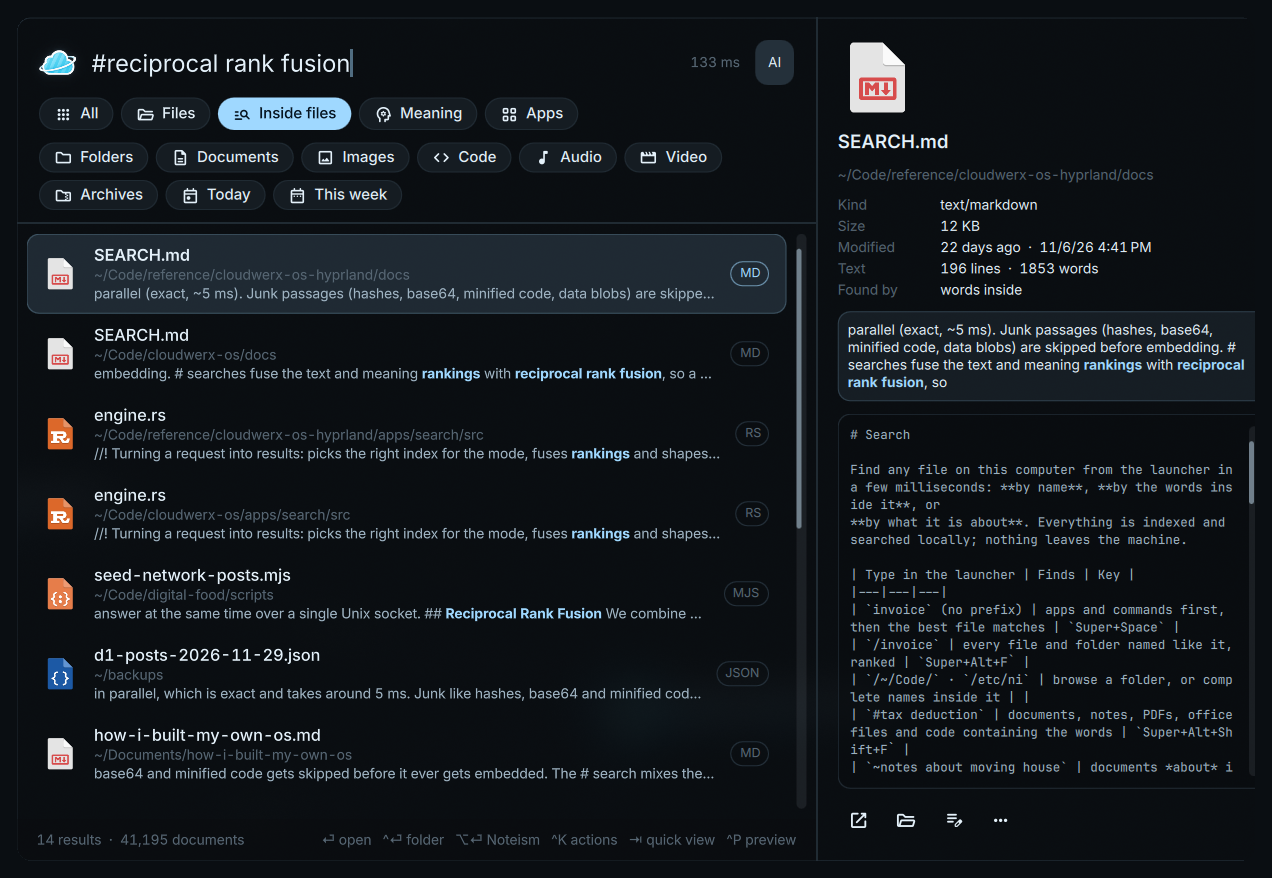
Full-text search fails the second you forget what words you wrote. Maybe your note says "CachyOS Btrfs snapshots with Snapper and Limine", and three weeks later you search "roll back operating system update snapshot". None of "roll", "operating", "system", or "update" show up cleanly together.
Usually, local semantic search means running a transformer model (ONNX, llama.cpp, or a Python server), waiting seconds per file during indexing, and chewing through battery.
Instead, cloudwerx-searchd uses Model2Vec (model2vec-rs) with MinishLab's minishlab/potion-retrieval-32M. Model2Vec distills a sentence transformer (BAAI/bge-base-en-v1.5 in this case) down into a static token embedding table of 512-dimensional vectors (~32.3M parameters). There is no attention layer and no transformer forward pass at runtime. Embedding a passage is literally tokenizing, looking up each token's 512-float vector in a table, and averaging them. It scores 35.06 on MTEB Retrieval (over 81% of all-MiniLM-L6-v2) at hundreds of times the speed on plain CPU.
Filtering junk before it pollutes the vector store
Source trees and home folders are full of garbage that looks like text: SHA-256 hashes, base64 blobs, JWTs, lockfiles, minified bundles. Embed those and your vector space fills up with junk.
semantic.rs splits prose into roughly 700-character passages (CHUNK_CHARS = 700, capped at 200 passages per file) along paragraph, line, sentence, and word boundaries, prepends a cleaned filename title (tax_return-2025.pdf becomes tax return 2025), and runs is_prose() on every chunk before embedding:
- At least 4 whitespace-delimited words and 12 alphanumeric characters
- Average word length $\le 14.0$ characters
- At least 50% of words must be at least half alphabetic letters
- At most 20% of words can exceed 30 characters
That simple five-line heuristic deletes base64, hex dumps, and minified JS before they ever reach the embedder.
4x smaller vectors with scalar int8 quantization
Right now the semantic store holds 483,857 passages across 37,245 files at 512 dimensions.
If you keep 483,857 512-dim vectors in f32, the raw vectors alone eat:
$$ 483{,}857 \times 512 \times 4\text{ bytes} \approx 990.9\text{ MB} $$
Instead, semantic.rs quantizes each passage vector independently to signed 8-bit integers (i8) with a single f32 scale factor per passage:
$$ s = \frac{\max_i |v_i|}{127.0}, \qquad q_i = \text{clamp}!\left(\text{round}!\left(\frac{v_i}{s}\right), -127, 127\right) $$
At query time, the query vector $u$ stays in f32, and scoring a passage is an integer-to-float multiply-accumulate scaled once at the end:
$$ \text{score}(q, u) = s \sum_{i=1}^{512} q_i , u_i $$
That drops the raw vector array from 990.9 MB down to 247.7 MB (483,857 * 512 bytes, plus 1.9 MB for scales), and the entire 395 MiB). And because it's one flat contiguous vectors.bin file on disk (including all 37,245 file paths and 280-char passage previews) is 414,332,427 bytes (Vec<i8> chunked in parallel via vecs.par_chunks(dim * 1024), an exhaustive exact search across all 483,857 passages finishes in 21 to 45 ms with zero approximate-nearest-neighbor index (no HNSW graph RAM overhead, no stale deletions, exact top-k).
Blending words and meaning with Reciprocal Rank Fusion
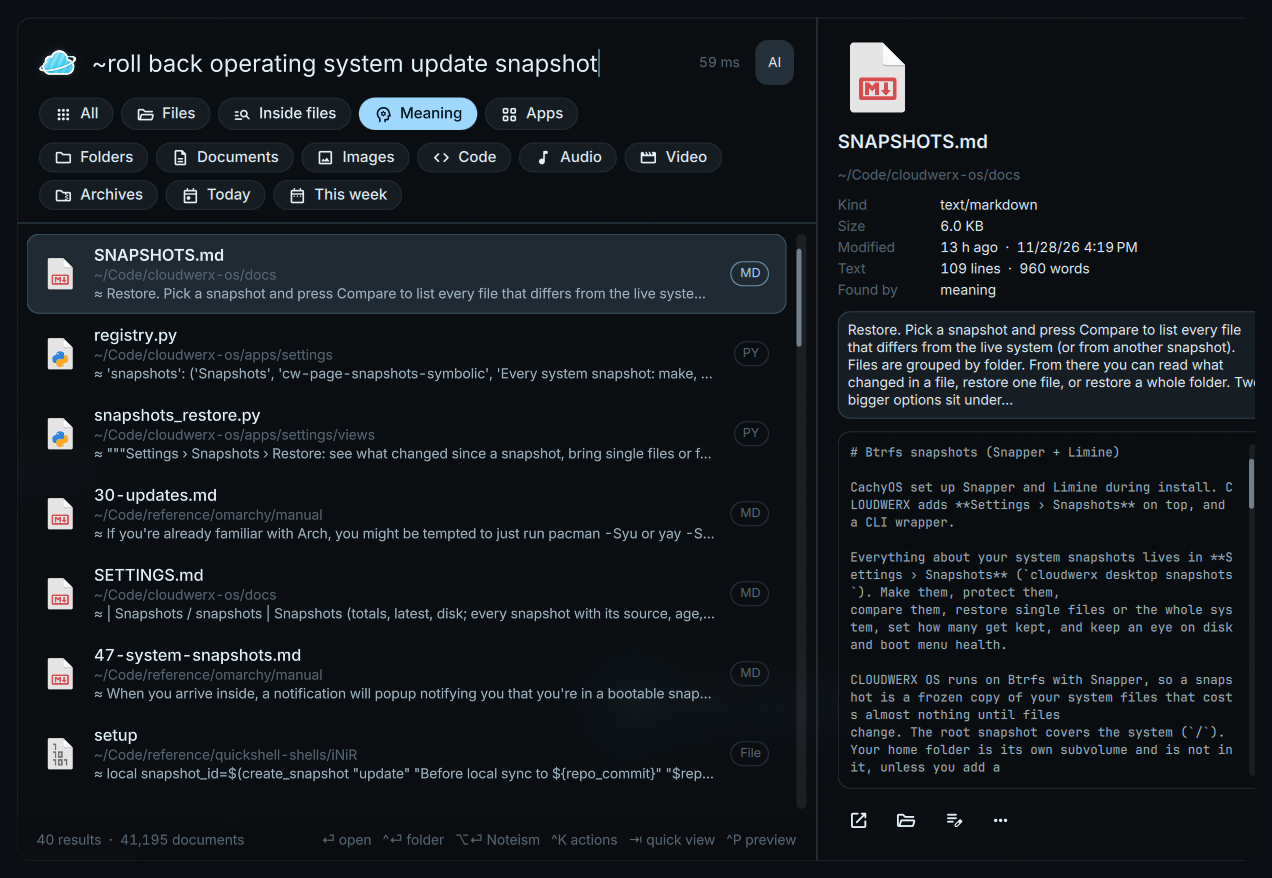
When you use # mode (Inside files), engine.rs runs both Tantivy BM25 and the Model2Vec vector search, then combines them using Reciprocal Rank Fusion (RRF) from Cormack, Clarke, and Büttcher's 2009 SIGIR paper.
The whole reason RRF works so well in hybrid search is that BM25 scores (unbounded positive floats like 14.8) and cosine similarities (0.0 to 1.0) are on completely incomparable scales. RRF ignores raw scores and fuses by rank position $r(d)$ with smoothing constant $k = 60$:
$$ \text{RRF}(d) = \frac{1}{60 + r_{\text{BM25}}(d)} + \frac{0.9}{60 + r_{\text{sem}}(d)} $$
If a document ranks near the top in both keyword matching and meaning, it jumps straight to the top (source: "text+meaning"). If it matches only your words ("text") or only your intent ("meaning"), it still gets a fair shot.
The static-embedding trap (and the 0.45 gate)
Here is something you learn fast when shipping static embeddings in a real app: every vector store always has a nearest neighbor.
Type total nonsense like asdfqwer into a pure vector search and it will happily compute cosine similarities across 483,857 passages and return the "closest" 20 files with confidence. On potion-retrieval-32M, real semantic matches usually land between 0.50 and 0.75, while unrelated noise clusters around 0.30 to 0.47.
So engine.rs enforces two gates on semantic results:
- An absolute score floor:
0.45(HYBRID_FLOOR) when mixing into#keyword search, or0.30(MEANING_ONLY_FLOOR) in~meaning-only mode. - A relative cutoff: every hit must stay within
75%of the top hit's score in hybrid mode (HYBRID_REL = 0.75), or70%in meaning mode (MEANING_ONLY_REL = 0.70).
It also tracks the running mean $\mu$ and standard deviation $\sigma$ across all 483,857 passages during every scan so each hit carries its $z$-score ($z = (\text{score} - \mu)/\sigma$) for diagnostics.
Real numbers on my actual laptop
Numbers from unit tests on 50 synthetic files lie. Here are real timings measured directly against my running cloudwerx-search.sock across 14,330,935 name entries, 41,195 Tantivy documents, and 483,857 quantized passages:
| Mode | Query | Cold (ms) | Warm (ms) | What actually happened |
|---|---|---|---|---|
| Names | changelog in:~/Code/cloudwerx-os |
16.09 | 11.54 | Resolved folder to u32, walked subtree only |
| Names | semantic.rs |
26.06 | 16.40 | Global 14.3M scan, u64 mask + nucleo |
| Names | changelog |
113.67 | 30.19 | Global 14.3M scan across all mounts |
| Names | ext:frag in:~/Code/cloudwerx-os |
53.77 | 74.26 | No name word -> mask is 0, tests every extension |
| Meaning | how do I make the desktop look different |
40.56 | 21.84 | Exhaustive dot product over 483,857 int8 vectors |
| Meaning | roll back operating system update snapshot |
31.19 | 31.19 | Returned docs/SNAPSHOTS.md #1 without keyword match |
Hybrid # |
shader transition |
350.76 | 67.89 | Tantivy BM25 + FST prefix + int8 RRF fusion |
Hybrid # |
reciprocal rank fusion |
451.58 | 391.31 | Multi-term BM25 + snippet generation over 41k docs |
Look at row 4 (ext:frag): it's actually slower than searching "semantic.rs" across 14.3 million files! Why? Because without a filename pattern, needle_mask is 0, so the 64-bit bitmask shortcut passes everything and score_entry has to inspect extensions across entries. That one measurement immediately shows why the bitmask does almost all the heavy lifting.
[!INFO]- Live daemon stats (
cloudwerx search status --json){ "memory": 975601664, "disk": 778281021, "names": { "files": 13923933, "folders": 407002, "scan_ms": 36121, "watched": 140346, "watch_limit": 1048576 }, "content": { "documents": 41195, "state": "ready" }, "meaning": { "model": "potion-retrieval-32M", "files": 37245, "passages": 483857, "bytes": 414332427 } }
Live config and Settings integration
The Settings UI (cloudwerx desktop search) writes straight to search in ~/.config/cloudwerx/settings.json, and the same inotify watcher monitors that config file for CLOSE_WRITE. Save a change in Settings (turn off PDF indexing, add an exclusion folder, swap from potion-retrieval-32M to potion-base-8M or potion-multilingual-128M) and cloudwerx-searchd diffs the scope string and rebuilds only the affected index without restarting the service.
It also keeps a manifest.json mapping each file path to (mtime, size, flags) where the bit flags track whether it was embedded or failed extraction. On restart, it skips everything unchanged, commits incremental batches every 800 files or 20 seconds (newest files first!), and checks its live-event channel between batches (interleave_live) so a file you edit while a big sync is running still shows up immediately.
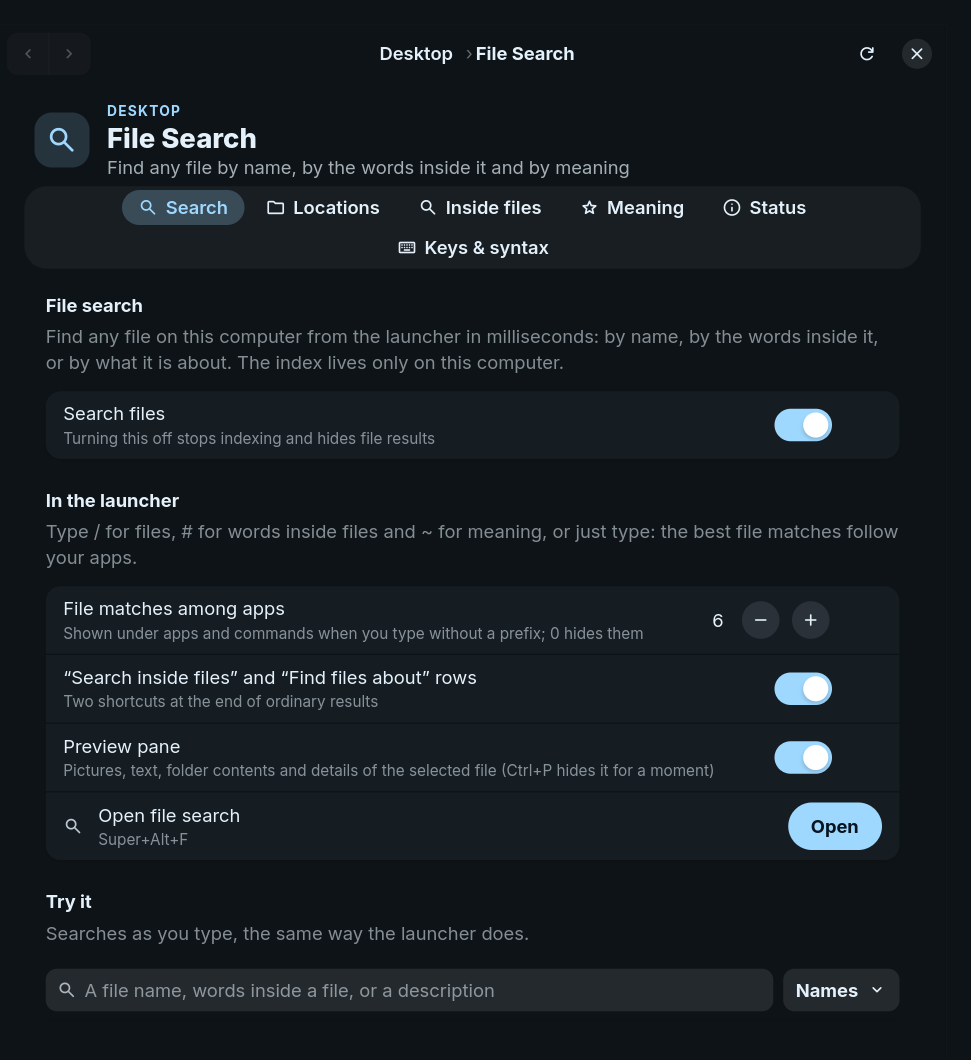
If you're building a local search tool in Rust, here's the cheat sheet I wish I had on day one: pack metadata into flat Copy structs with a shared string arena, put a character bitmask in front of your fuzzy matcher, skip QueryParser in favor of FST prefix expansion if you care about search-as-you-type, quantize static Model2Vec embeddings to i8, and gate your semantic floor hard before fusing with RRF. You get Windows Everything speed, Lucene-grade text matching, and offline conceptual search in one tiny binary, and nothing ever leaves your laptop.
If you want to see how this ties into the rest of the desktop, check out the Btrfs snapshot rollback stack (the same docs ~roll back operating system update snapshot surfaced in 31 ms) or my theme engine.
Sources
- CLOUDWERX OS (
apps/search) - helix-editor/nucleo (parallel fuzzy matcher)
- quickwit-oss/tantivy (Rust full-text search engine)
- MinishLab/model2vec (static embedding distillation)
- minishlab/potion-retrieval-32M on Hugging Face
- Cormack, Clarke, Büttcher (SIGIR 2009): Reciprocal Rank Fusion
- Linux
fanotify(7)manual page - Linux
inotify(7)manual page - voidtools Everything